


Buffalo Architecture: A Guide
Buffalo Architecture: A Guide
Couldn't load pickup availability
Book Notes: Contains minor shelf wear. Pages are clean and in great shape. Binding is tight.
Author(s): Reyner Banham, Charles Beveridge, Henry-Russell Hitchcock, Buffalo Architectural GuidebookPrint: 4th Print
Publication year: 1981
Publication date: 1981-10-19
Pages: 336
Binding: Paperback
Language: English
Publisher: The MIT Press
ISBN: 026252063XDimensions: 9.02 x 5.04 x 0.68 in
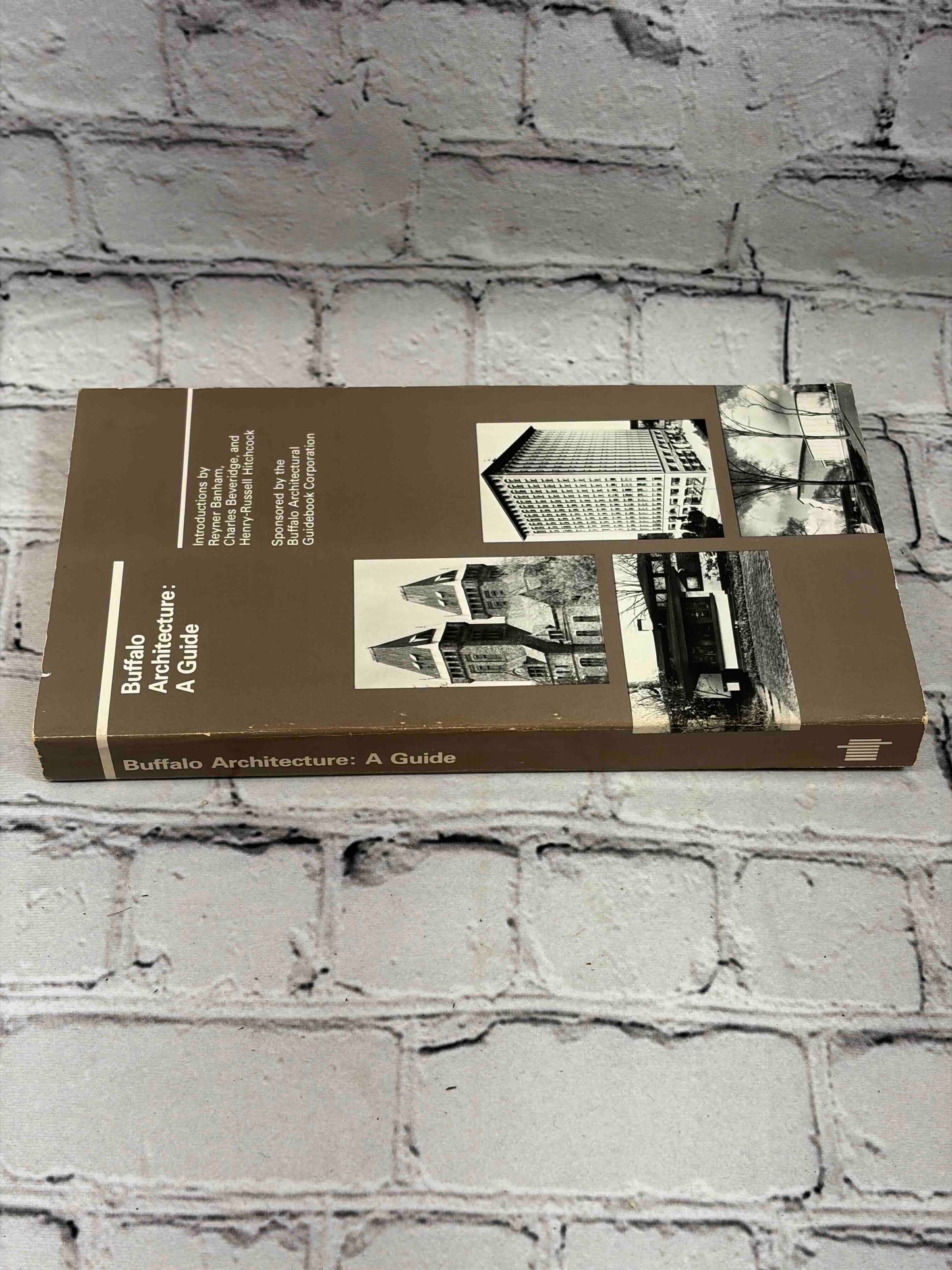
Buffalo's rich architectural and planning heritage has attracted the attention of several prominent historians, whose work here is accompanied by over 250 illustrations and photographs.
For its size, the city of Buffalo, New York, possesses a remarkable number and variety of architectural masterpieces from the late nineteenth and early twentieth centuries: Adler and Sullivan's Prudential building, H. H. Richardson's massive Buffalo State Hospital, Richard Upjohn's Sr. Paul's Episcopal Cathedral, five prairie houses by Frank Lloyd Wright, and building by Daniel Burnham, Albert Kahn, and the firms of McKim, Mead, and White, and Lockwood, Green and Company, among others.
These structures by prominent "outsiders" served to spur the efforts of local architects, builders, and craftsmen, and all of them built within the context of the city-wide park and parkway system designed by Frederick Law Olmsted. In addition, the city and its environs exhibit representative works by more recent architects, among them Eero and Eliel Saarinen, Walther Gropius, Marcel Breuer, Paul Rudloph, Minoru Yamasaki, and the firm of Skidmore, Owings, and Merrill.
Buffalo's rich architectural and planning heritage has attracted the attention of several prominent historians, capable of the challenge of evaluating its significance. Reyner Banham is one of the world's leading authorities on the theory and practice of architecture, and he has written extensively on design in the industrial age (and Buffalo's innovative manufacturing plants and grain elevators are important exemplars of such design). Charles Beveridge, whose essay covers the park and parkway system, is editor of the Olmsted papers at The American University. And Henry Russell Hitchcock is the dean of American architectural historians, and the organizer of a 1940 exhibition on Buffalo's built environment.
Their essays are followed by seven sections that delineate the city's neighborhoods, each provided with a map, neighborhood history, and a full complement of photographs with descriptive building captions. An eighth section, "Lost Buffalo," describes demolished buildings, chief among them Wright's great Larkin administration building, while the remaining sections venture out of town, exploring Erie and Niagara Counties, other parts of Western New York, and southern Ontario.
Shipping & Returns
Shipping & Returns
Shipping costs are calculated based on the weight of the item and the delivery location. We ship via Media Mail or Ground Advantage through USPS.
Shop with Confidence!
We stand by the quality of our books. If for any reason you’re unsatisfied with your purchase, we offer a 100% full refund along with free return shipping.
Share


Book Condition Scale
-
Like New
This book is in excellent condition and appears to have been read only once. The pages are clean and unmarked, with no creases or stains. The binding remains firm and tight. There may be minimal signs of shelf wear on the cover or dust jacket, but overall, the book looks and feels nearly new.
-
Very Good
This book has been read but remains in great condition. It does not look new, yet there is no obvious damage to the cover. Wear and tear are minimal. The pages are clean, free of highlighting or notes, though it may contain identifying marks from a previous owner or bookstore.
-
Good
This book shows moderate to heavy signs of wear that can include creases, stains or tears. The cover may have minimal damage, and the binding remains intact with slight wear. The majority of pages are undamaged, though there may be some highlighting, underlining, or notes. It may also contain identifying marks from a previous owner or bookstore.
-
Acceptable
This book shows significant wear, which may include tears, large stains, creases, loose pages, and heavy notes, underlining, or highlighting. The binding may be loose but remains intact. While it has noticeable imperfections, it is still a complete and readable copy. Any major defects will be clearly noted in the listing.
-
As Described
This book is visibly worn and may be heavily soiled, scuffed, stained, or spotted. It may have loose joints, hinges, or pages, and some text or pages may be missing. Large tears and other significant defects may be present. While still a readable copy, it shows substantial signs of use. Any major flaws will be clearly noted in the listing.
-
Dust Jacket Grading
(A) Excellent
The dust jacket is in excellent condition, may show the slightest signs of shelf wear, if any.(B) Good
Shows minor shelf wear, usually along edges and may have a few light stains.(C) Fair
Displays moderate shelf wear, including some noticeable small tears, creasing and/or stains.(D) Poor
Contains large tears, several creases, and/or heavy staining.(F) As Is
Shows significant wear and tear. Majority of dust jacket is torn or missing. May contain heavy staining.
