


Gateway to Japan (Kodansha Guide)
Gateway to Japan (Kodansha Guide)
Couldn't load pickup availability
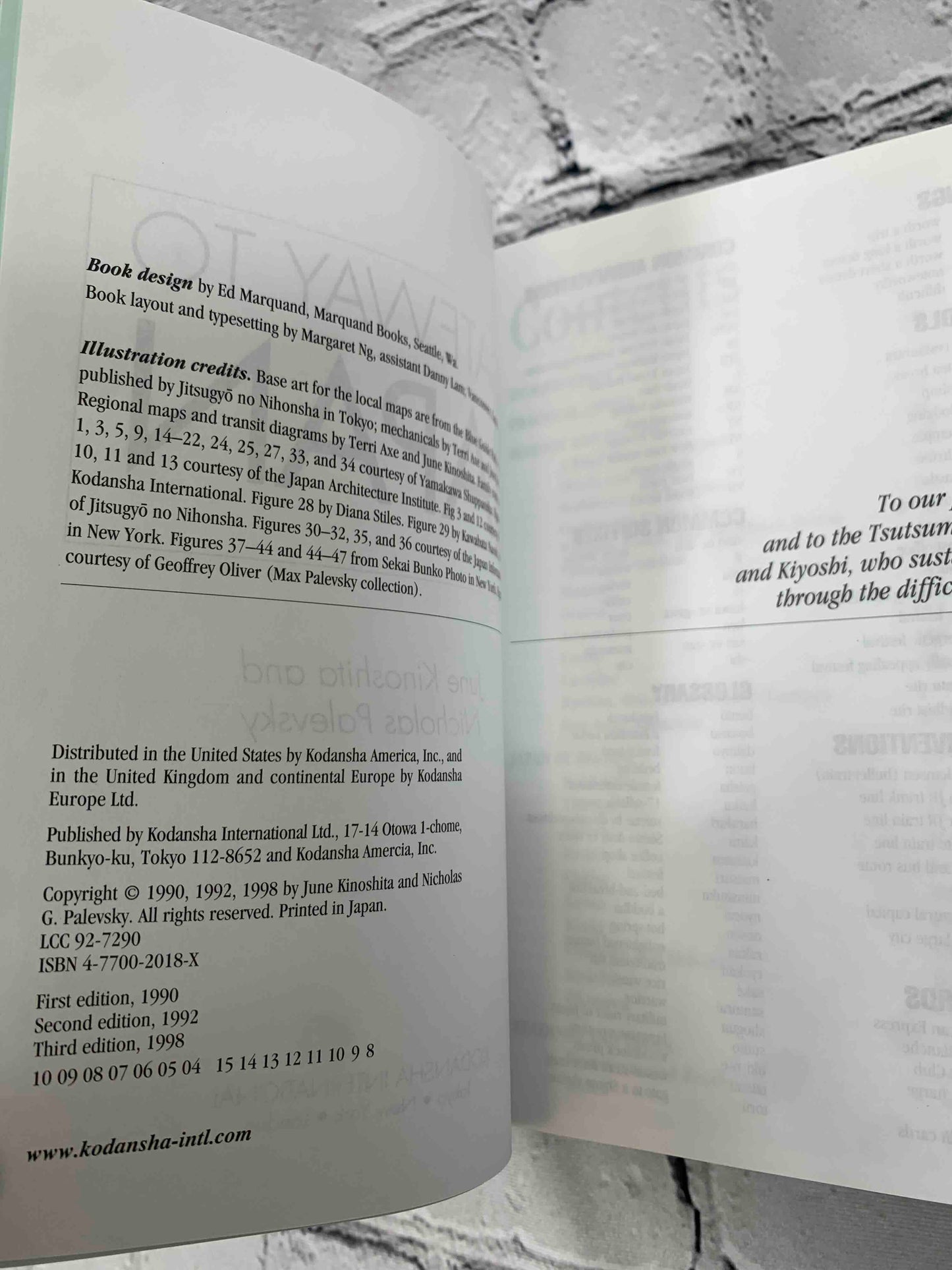
Author(s): June Kinoshita, Nicholas Palevsky
Edition: 3rd Edition
Publication year: 1998
Publication date: 1998-06-10
Pages: 808
Binding: Paperback
Language: English
Publisher: Kodansha USA
ISBN: 9784770020185Dimensions: 7.4 x 1.3 x 5.1 in
When friends want to know where to go in Japan, I always ask, "What are you interested in?" One friend spent every day at the Kabuki theater in Tokyo. Another ventured north to savor the culinary traditions of Tohoku. We know people who adore Tokyo, exulting in the energy of the world's most futuristic megapolis. Others loath it and flee to tranquil Kyoto, the former imperial city that epitomizes the refinement of traditional culture. Still others visit both cities and marvel at the extremes represented by these opposing poles of the Japanese experience. The diversity of cultural and geographic offerings can be intimidating. The two sections of this book, History and Culture and Japan by Region, are designed to make them more manageable. History and Culture focuses on specific topics and recommends where to go. Japan by Region gives the practical information you need to make the trip.
History and Culture
"A Brief History" introduces the major historical periods and includes a list of the most important figures in Japanese history and culture; their names appear in uppercase letters throughout the book. The chapters that follow provide both an overview and a practical reference on various subjects. For example, "Cuisine" contains bilingual "menus" from which you can order food in restaurants. Most of the chapters conclude with a list of recommendations. Any place that is mentioned in both the main text and the list appears in uppercase.
Japan by Region
The ten regional chapters appear in geographic order, from north to south (see map on p. vi). The largest of Japan's four main islands, Honshu, and the smallest, Shikoku, together make up seven chapters. The remaining three chapters are devoted to Hokkaido, Kyushu, and the Okinawan archipelago. Each chapter begins with a brief introduction and lists the best attractions, special interests, and seasonal events.
Transit Diagrams
The transit diagram at the beginning of each regional chapter shows the main trunk line (usually the bullet train) traversing the region, together with other train and bus lines that branch off. The main junctions on the trunk line are assigned roman numerals and treated as jumping-off points from which to explore side routes; the stations along the side routes are assigned arabic numerals. The text describes in numerical order each main junction, followed by the side routes; their direction is denoted by the letters "N" for north, "E" for east, and so forth. For example, suppose you want to visit Dewa Sanzan (transit key number IV:W3) in Tohoku. To see how to get there, turn to the Tohoku transit diagram (p.152); go down the trunk line to the fourth city, Sendai, then go west three notches. The text follows the same organization and is, in effect, a series of mini-itineraries.
Dining, Lodgings, and Local Maps
Dining and lodging facilities are listed at the end of each town or locale. Telephone area codes are usually listed beside the lodgings heading. Shops, restaurants, and hotels will appear on local maps according to a number-key system. (See inside front cover for a key to symbols.) Ratings are awarded on a scale of from one to three stars based on quality, service, and atmosphere. Credit-card information is supplied for every establishment for which the information was available.
Shipping & Returns
Shipping & Returns
Shipping costs are calculated based on the weight of the item and the delivery location. We ship via Media Mail or Ground Advantage through USPS.
Shop with Confidence!
We stand by the quality of our books. If for any reason you’re unsatisfied with your purchase, we offer a 100% full refund along with free return shipping.
Share


Book Condition Scale
-
Like New
This book is in excellent condition and appears to have been read only once. The pages are clean and unmarked, with no creases or stains. The binding remains firm and tight. There may be minimal signs of shelf wear on the cover or dust jacket, but overall, the book looks and feels nearly new.
-
Very Good
This book has been read but remains in great condition. It does not look new, yet there is no obvious damage to the cover. Wear and tear are minimal. The pages are clean, free of highlighting or notes, though it may contain identifying marks from a previous owner or bookstore.
-
Good
This book shows moderate to heavy signs of wear that can include creases, stains or tears. The cover may have minimal damage, and the binding remains intact with slight wear. The majority of pages are undamaged, though there may be some highlighting, underlining, or notes. It may also contain identifying marks from a previous owner or bookstore.
-
Acceptable
This book shows significant wear, which may include tears, large stains, creases, loose pages, and heavy notes, underlining, or highlighting. The binding may be loose but remains intact. While it has noticeable imperfections, it is still a complete and readable copy. Any major defects will be clearly noted in the listing.
-
As Described
This book is visibly worn and may be heavily soiled, scuffed, stained, or spotted. It may have loose joints, hinges, or pages, and some text or pages may be missing. Large tears and other significant defects may be present. While still a readable copy, it shows substantial signs of use. Any major flaws will be clearly noted in the listing.
-
Dust Jacket Grading
(A) Excellent
The dust jacket is in excellent condition, may show the slightest signs of shelf wear, if any.(B) Good
Shows minor shelf wear, usually along edges and may have a few light stains.(C) Fair
Displays moderate shelf wear, including some noticeable small tears, creasing and/or stains.(D) Poor
Contains large tears, several creases, and/or heavy staining.(F) As Is
Shows significant wear and tear. Majority of dust jacket is torn or missing. May contain heavy staining.
