


Kunisada: Kabuki Actor Portraits
Kunisada: Kabuki Actor Portraits
Couldn't load pickup availability
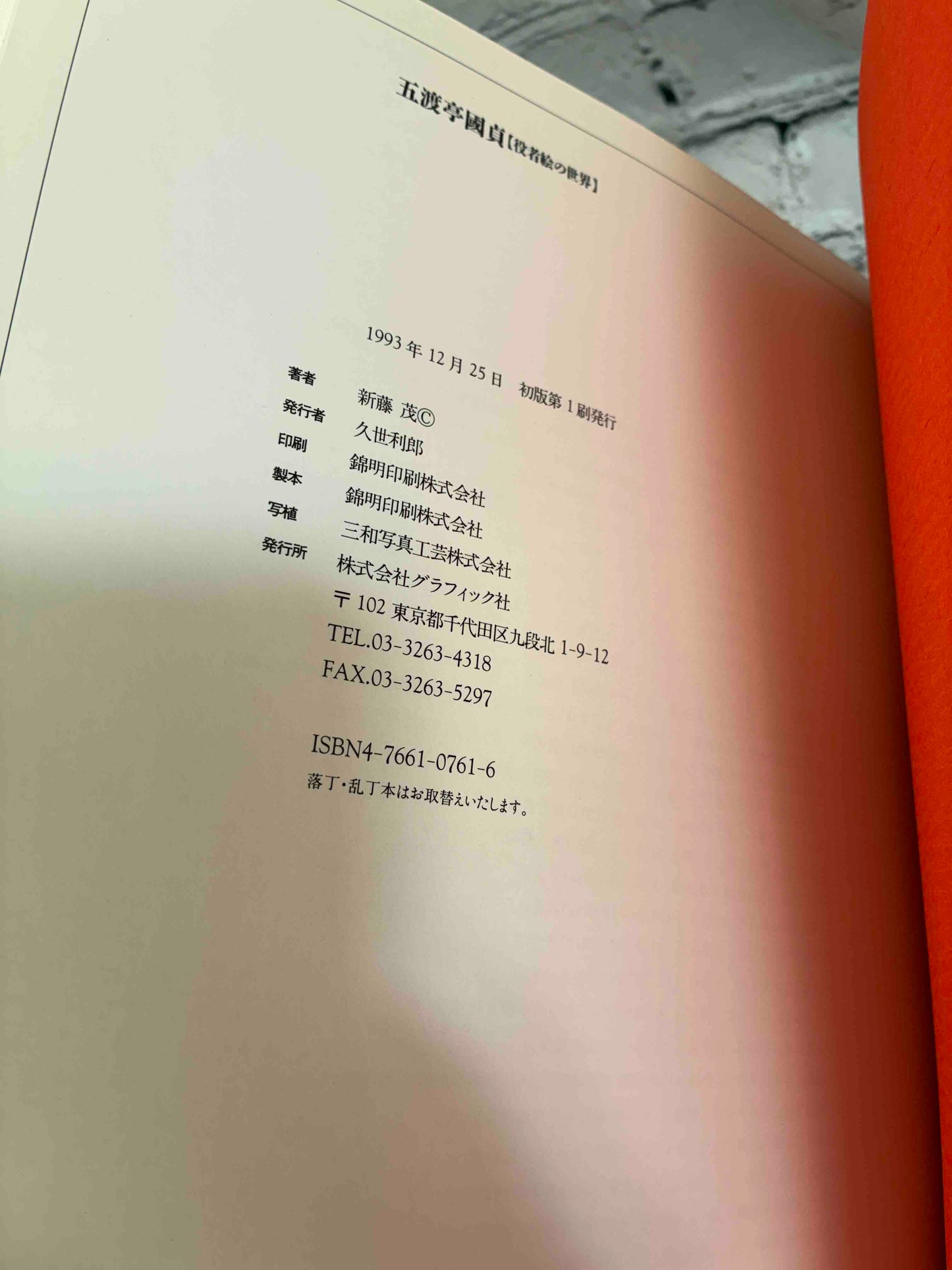
Author(s): Sigeru Shindo
Publication year: 1993
Publication date: 1993-01-01
Pages: 159
Binding: Paperback
Language: English
Publisher: Graphic Sha Pub Co
ISBN: 9784766107616Dimensions: 9.25 x 0.75 x 12.0 in
Ukiyoe prints may be classified by genre, encompassing among others beauty, scenic, cartoon, erotic, or actor prints. The latter has been the least explored of all genres. While the actor prints of Sharaku have certainly not been ignored, the art of Sharaku has been over-shadowed by questions surrounding the identity of the man himself. His actor prints have, as a consequence, yet to receive the attention and study they deserve.
The year 1994 marks the 200th anniversary of Sharaku's comet-like appearance in 1794 (Kansei 6). In comparison to the startling brevity of this artist's ten-month period of activity, Kunisada was an extraordinarily productive artist for more than a half-century - his first known work was executed in 1807 (Bunka 4). It is now 130 years since his death at the age of 79 in 1864 (Genji 1).
Coincidentally, it was in the year 1964, the centenary of Kunisada's death, that I encountered his actor prints for the first time. The very first book I ever purchased, Ukiyoe, bore the pronouncement, "Utamaro's beauty prints represent the summit of the genre. The last great achievements in actor prints belong to Sharaku... The decline in the quality of Ukiyoe that followed explains why specialists have applied the pejorative expression fin de siecle to describe Ukiyoe produced after the Bunka Bunsei period." I was hardly surprised, therefore, to discover later that the actor prints produced after Sharaku have for the most part been overlooked by researchers. This neglect undoubtedly accounts for the mistaken, indeed astonishing, judgement found in nearly all Ukiyoe guidebooks that the actor prints of Kunisada diminished in quality as the artist grew older and more productive.
Unfortunately, this lack of critical and historical awareness has only worsened. The low esteem in which actor prints are now held is a direct consequence of the pervasive notion that such prints occupy a rank well below those of beauty and scenic art. My own view is quite the opposite. The successful actor print demands the highest levels of workmanship of vision and control, as the individual artist confronts the challenge of conveying both the actor's individual style and narrative role without sacrificing his own artistic personality and requirements. As the work collected here so powerfully confirms, Kunisada committed himself without reserve to exploring this three-fold structure.
The question naturally arises of why these prints have not been more highly valued. Two factors are essential.
There is first the daunting and often laborious task for the researcher of understanding the history and the art of Kabuki itself, not only with respect to the dramatic structure of a certain role but also to the precise chronological determination of play performance and publication.
The second factor is very simply the enormous quantity of work that Kunisada produced. It does appear that apprentices assisted in the execution of much of Kunisada's later work. The Utagawa school seems to have become a studio workshop from the first Toyokuni period, and it is therefore likely that in his youth Kunisada also executed work for Toyokuni. The practise of using apprentices to some degree lasted until the appearance of two Meiji Period artists, Kunichika and Chikanobu. The inevitable confusion that arose over time as to the authenticity of a given work has no doubt contributed to the tendency of specialists to attach to Kunisada's later work meaningless evaluations of the kind already cited.
We tend to evaluate an artist in terms of his major accomplishments. For Kunisada, strangely enough, the reverse has applied, having been judged by what must be considered his least significant work, and this despite being the most prolific of all Ukiyoe artists, the inheritor at 59 of the Toyokuni name, and being acclaimed as Master Toyokuni, the supreme technician of his age. The popular esteem in which he was held exceeded that even of Hokusai and Hiroshige. His talent overwhelmed his contemporaries. The absence of his name in Japanese history textbooks is, considering all of this, nothing short of remarkable.
Shipping & Returns
Shipping & Returns
Shipping costs are calculated based on the weight of the item and the delivery location. We ship via Media Mail or Ground Advantage through USPS.
Shop with Confidence!
We stand by the quality of our books. If for any reason you’re unsatisfied with your purchase, we offer a 100% full refund along with free return shipping.
Share


Book Condition Scale
-
Like New
This book is in excellent condition and appears to have been read only once. The pages are clean and unmarked, with no creases or stains. The binding remains firm and tight. There may be minimal signs of shelf wear on the cover or dust jacket, but overall, the book looks and feels nearly new.
-
Very Good
This book has been read but remains in great condition. It does not look new, yet there is no obvious damage to the cover. Wear and tear are minimal. The pages are clean, free of highlighting or notes, though it may contain identifying marks from a previous owner or bookstore.
-
Good
This book shows moderate to heavy signs of wear that can include creases, stains or tears. The cover may have minimal damage, and the binding remains intact with slight wear. The majority of pages are undamaged, though there may be some highlighting, underlining, or notes. It may also contain identifying marks from a previous owner or bookstore.
-
Acceptable
This book shows significant wear, which may include tears, large stains, creases, loose pages, and heavy notes, underlining, or highlighting. The binding may be loose but remains intact. While it has noticeable imperfections, it is still a complete and readable copy. Any major defects will be clearly noted in the listing.
-
As Is
This book is visibly worn and may be heavily soiled, scuffed, stained, or spotted. It may have loose joints, hinges, or pages, and some text or pages may be missing. Large tears and other significant defects may be present. While still a readable copy, it shows substantial signs of use. Any major flaws will be clearly noted in the listing.
-
Dust Jacket Grading
(A) Excellent
The dust jacket is in excellent condition, may show the slightest signs of shelf wear, if any.(B) Good
Shows minor shelf wear, usually along edges and may have a few light stains.(C) Fair
Displays moderate shelf wear, including some noticeable small tears, creasing and/or stains.(D) Poor
Contains large tears, several creases, and/or heavy staining.(F) As Is
Shows significant wear and tear. Majority of dust jacket is torn or missing. May contain heavy staining.
